No job history yet? Here is exactly how to write a strong first CV using your education, projects, and volunteer work, with a full example and template structure. How to Write a CV With No Work Experience: A Complete Guide for Students and First-Time Job Seekers You have finished school, maybe you just got your …
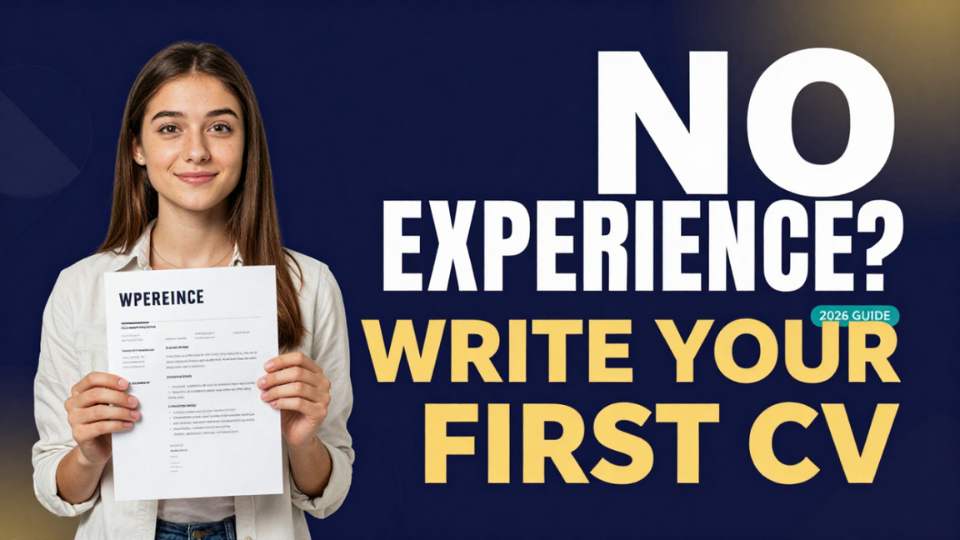
No job history yet? Here is exactly how to write a strong first CV using your education, projects, and volunteer work, with a full example and template structure.
Table of Contents
ToggleHow to Write a CV With No Work Experience: A Complete Guide for Students and First-Time Job Seekers
You have finished school, maybe you just got your WAEC, KCSE, WASSCE, or GCE result, maybe you are finishing university or your first year of NYSC, and now you need a CV. There is just one problem. Every job listing asks for experience, and you do not have any yet.
This is one of the most common frustrations for first-time job seekers, and it is also one of the easiest to solve once you understand something most people miss. Employers hiring for entry-level roles, internships, and graduate positions are not expecting a long work history. They are looking for evidence that you can learn quickly, show up reliably, and communicate clearly. None of that requires a paid job. It requires knowing how to present what you already have in a way that actually shows it.
This guide walks through exactly how to build that CV, section by section, with a full example at the end.
Why “No Experience” Is the Wrong Way to Think About This
The mistake almost every first-time CV writer makes is thinking about their CV in terms of what is missing. This shows up as a nearly empty Work Experience section, or worse, an apologetic line explaining the lack of experience. Neither helps you.
Experience, in the way employers actually use the word for entry-level hiring, is broader than paid jobs. It includes:
School and university projects, especially group projects, final year projects, or coursework tied to real problems
Volunteer work, whether structured through an organization or informal, like helping run a community initiative
Leadership roles in clubs, student unions, religious organizations, or sports teams
Freelance or informal work, including tutoring, running a small side business, or content creation
Internships or industrial attachment placements, even short or unpaid ones
Online courses and certifications you have actually completed, not just started
Every one of these can be written using the same structure as a formal job entry, with a title, an organization or context, dates, and a few lines describing what you did and what came out of it. The goal is not to pretend you have paid work experience. It is to show, clearly, that you already have the habits and skills employers are actually screening for.
What Recruiters Are Actually Scanning For
Most recruiters spend well under a minute on a first read of any CV, and for entry-level and graduate roles specifically, they are typically scanning for a small set of signals rather than reading every line closely.
Reliability, meaning evidence you follow through and meet deadlines
Communication, meaning you can write and present clearly
Willingness to learn, since almost nothing about your first job will be something you already know how to do perfectly
Basic technical or subject-specific skills relevant to the role
A growing number of employers, including most medium and large companies, also run CVs through an Applicant Tracking System before a human ever reads them. This system scans for keywords matching the job description and for a format it can parse correctly. This means two very practical things for your CV. First, pull specific skills and terms directly from the job description you are applying to, since a scanning system is often looking for exact or close keyword matches. Second, keep your formatting simple. Avoid tables, text boxes, columns, and heavy graphics, since these frequently confuse ATS software and can cause parts of your CV to be skipped entirely or read in the wrong order.
The Structure That Works
Contact Information
Keep this to the essentials, your full name, phone number, professional email address, and city or state. Leave out anything unnecessary like your full home address, marital status, or a photo, unless a specific employer or country’s application norms explicitly expect one.
Professional Summary
Replace the outdated “Objective” statement, which typically describes what you want, with a short summary of two to three sentences describing what you offer. This is your first real chance to make an impression, so avoid vague language and instead mention your field of study, your strongest relevant skill, and what kind of role you are seeking.
Weak example: “Recent graduate seeking an entry-level position where I can grow and learn new skills.”
Stronger example: “Recent Business Administration graduate with hands-on experience coordinating a 200-attendee campus fundraising event and strong skills in Microsoft Excel and basic financial reporting. Seeking an entry-level role in operations or administration.”
The second version tells an employer something specific and useful within the first five seconds of reading.
Education
For a first CV, education usually belongs near the top, right after your summary, since it is currently your strongest asset. List your degree or certificate, your institution, your graduation date or expected graduation date, and your grade if it is strong. Underneath, you can list relevant coursework, your final year project title with a one-line description, and any academic awards.
Experience, Projects, and Volunteer Work
This is the section that replaces a traditional Work Experience list, and it is where most of your effort should go. Combine relevant projects, volunteer roles, internships, and any paid or informal work into one section, ordered by relevance and recency rather than strictly by whether you were paid.
Write each entry like a mini job, with a clear title, the organization or context, the dates involved, and two to three bullet points describing what you actually did and what resulted from it. Where possible, include a number. Numbers make a claim concrete and easy for a recruiter to evaluate quickly.
Weak bullet: “Helped organize a school event.”
Stronger bullet: “Coordinated logistics for a 150-student inter-departmental sports event, managing a team of eight volunteers and a budget of fifty thousand naira.”
If you genuinely have no numbers to attach to something, describe the scope and outcome as specifically as you can instead of leaving it vague.
Skills
List specific, relevant skills rather than generic personality traits. Technical skills, like specific software, tools, or languages, carry more weight with both ATS systems and human recruiters than broad claims like “hardworking” or “team player,” which every CV says and which are only convincing if something elsewhere in your CV actually backs them up.
Group your skills into categories if you have several, for example Technical Skills and Languages, so the section stays scannable rather than becoming one long unstructured list.
Certifications and Additional Training
If you have completed any recognized online courses, professional certifications, or short training programs relevant to the role, list them here with the issuing organization and the date completed. Courses you started but did not finish do not belong on your CV.
Optional Sections
Depending on space and relevance, you can add a short section for languages spoken, especially if you are bilingual or multilingual, which is a genuine asset in many roles. You can also add two or three relevant hobbies if they say something specific about you, for example a hobby involving writing, coding, or public speaking that reinforces a skill relevant to the job. Avoid a long, generic hobbies list that adds nothing.
Formatting Rules That Actually Matter
Keep your first CV to one page. At this stage in your career, you do not yet have enough genuinely relevant material to justify two pages, and packing a thin CV across two pages with extra white space looks worse than a tight, well-used single page.
Use a standard, readable font at 10 to 12 point size, and stick to conventional section headings like Education, Experience, and Skills rather than creative alternatives, since both ATS software and human recruiters scan faster when headings are exactly what they expect to see.
Use consistent formatting throughout, the same date format, the same bullet style, the same heading style. Small inconsistencies are one of the fastest ways a CV signals a lack of attention to detail before a recruiter has read a single sentence of content.
Save and submit your CV as a PDF unless an application specifically asks for another format, since PDF preserves your formatting exactly as you designed it across any device or system that opens it.
Tailoring Your CV for Each Application
A CV that tries to say everything to everyone usually says nothing memorable to anyone. Before submitting, read the actual job description and adjust your summary and your bullet points to reflect the specific language and priorities in that posting. If a listing repeatedly mentions attention to detail and customer communication, make sure those exact themes show up clearly in your bullet points, using your own real experience to demonstrate them rather than simply copying the phrase.
This matters for two reasons. It significantly improves your chances of matching ATS keyword screening, and it shows a human reader that you actually read their posting carefully rather than mass-applying with an identical CV everywhere.
Common Mistakes to Avoid
Writing an apology into your CV. Never include a line like “Despite having no work experience” or similar. It draws attention to the exact gap you are trying to fill with everything else on the page.
Leaving the Experience section empty rather than populating it with projects, volunteering, and other relevant activities.
Using an outdated Objective statement instead of a value-focused Professional Summary.
Overloading the page with a long, generic list of soft skills unsupported by any actual example elsewhere in the CV.
Inconsistent formatting, mismatched fonts, uneven spacing, or inconsistent date formats.
Submitting the exact same CV to every application without adjusting it to match the specific role.
Using a complex, heavily designed template with columns, graphics, or text boxes that risk being misread or skipped entirely by ATS software.
A Full Example
Below is a simplified example of how these sections come together for a recent graduate with no formal paid work experience.
Professional Summary Recent graduate in Computer Science with hands-on experience building a final year project used by over sixty students, and strong skills in Python and basic web development. Seeking an entry-level software development or IT support role.
Education BSc Computer Science, University of Lagos, Graduated 2026 Final year project: Built a web-based attendance tracking system adopted by two departments within the university Relevant coursework: Data Structures, Database Systems, Web Development
Experience and Projects Student Developer, University Coding Club, 2025 to 2026 Built and maintained the club’s event registration website, used by over 300 students across two semesters Trained six incoming members on basic Git version control and collaborative coding practices
Volunteer IT Support, Local Community Center, 2024 to 2025 Provided basic computer literacy training to twenty adult learners over an eight week program Resolved routine hardware and software issues for the center’s shared computer lab
Skills Technical: Python, HTML, CSS, basic SQL, Git Other: Microsoft Office, Google Workspace
Certifications Introduction to Web Development, freeCodeCamp, Completed 2025
Notice that nothing in this example is a paid job, and it still reads as a complete, credible, specific CV that gives a recruiter clear evidence of skill, initiative, and reliability.
What to Do Once Your CV Is Ready
Once your first CV is built, treat it as a living document rather than something you finish once and forget. Update it every time you complete a new project, course, or piece of volunteer work, even small ones, so you are never starting from scratch again when the next opportunity comes up. Pair it with a short, tailored cover letter for each application, since a strong CV combined with a generic or missing cover letter is a very common reason a genuinely qualified first-time applicant gets passed over.
If you are not confident building the layout and formatting yourself, using a structured CV builder can save you from the formatting mistakes covered above, particularly around ATS compatibility, while still letting you write the actual content in your own words.
Frequently Asked Questions
Do I really need experience to get an entry-level job? No. Entry-level and graduate roles are specifically designed for candidates without a full work history. What matters is showing relevant skills and initiative through education, projects, and volunteer work, presented clearly.
Should I include a photo on my CV? This depends heavily on the country and industry you are applying in. In many markets, including most corporate roles in Nigeria, Kenya, Ghana, and Cameroon, a photo is optional and not required. Check common practice for your specific country and industry before deciding.
How long should a first CV be? One page. At this stage in your career, you do not yet have enough genuinely relevant content to justify more, and a tightly written single page reads stronger than a thin two-page CV.
What if I have absolutely no volunteer work, projects, or extracurricular activities? Start now. Even a short volunteer commitment, a small personal project, or a completed online course gives you real material to work with, and it is far easier to build this over a few weeks than to fabricate experience you do not have.
Should I list my hobbies on a CV with no work experience? Only if they are specific and relevant. Two or three hobbies that genuinely reflect a useful skill, for example writing, coding, or public speaking, can add something. A long generic list adds nothing and takes up space better used elsewhere

Brielle Kensington
Brielle Kensington is a career author and professional resume writer known for helping job seekers turn their experience into powerful personal stories. With a strong background in career development and modern hiring trends, she has helped hundreds of professionals craft resumes that stand out and get interviews.
Brielle specializes in writing clear, results-focused resumes, compelling cover letters, and LinkedIn profiles that attract recruiters. Her writing style is polished, strategic, and tailored to each client’s career goals. Through her books and career guides, she teaches simple but powerful strategies that help professionals confidently navigate today’s job market.
She believes every professional has a unique story, and the right words can open the right doors.