Learn exactly how Applicant Tracking Systems parse your resume, which formatting choices cause rejections, and how to build a CV that actually reaches a recruiter. How ATS Resume Scanners Actually Read Your CV Almost every mid-size and large company now runs job applications through an Applicant Tracking System before a human ever opens your CV. …
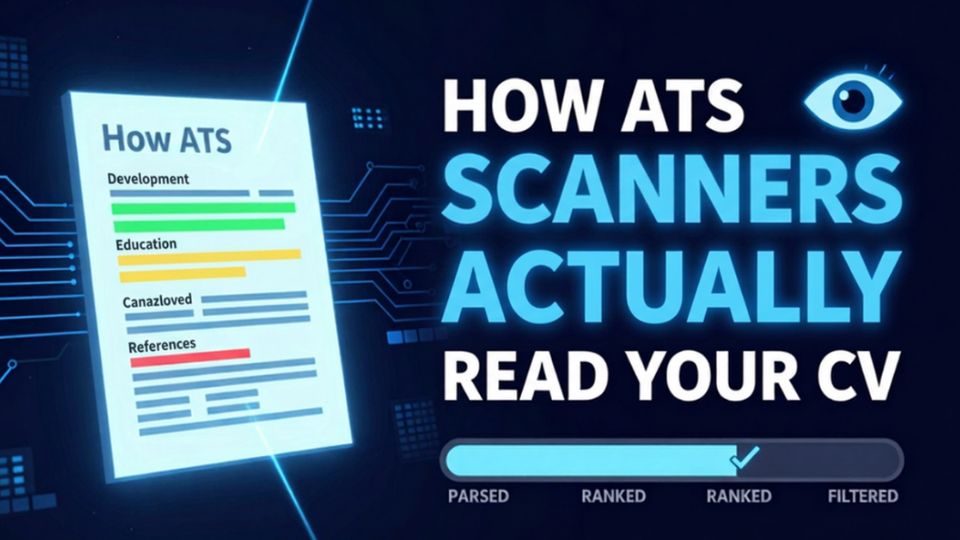
Learn exactly how Applicant Tracking Systems parse your resume, which formatting choices cause rejections, and how to build a CV that actually reaches a recruiter.
Table of Contents
ToggleHow ATS Resume Scanners Actually Read Your CV
Almost every mid-size and large company now runs job applications through an Applicant Tracking System before a human ever opens your CV. Recent industry data puts this figure close to universal, with recruiters reporting that virtually all keyword filtering happens automatically at this first stage, according to Jobscan’s State of the Job Search research. This means your resume is not first judged by a person. It is first judged by software, and that software has very specific, very mechanical rules about what it can and cannot read correctly.
This guide explains exactly what an ATS does when it receives your resume, which formatting choices quietly get you filtered out before a recruiter sees your name, and how to structure your CV so the system reads it the way you intend.
What an ATS Actually Does
An Applicant Tracking System is not one single piece of software. Major employers commonly run platforms like Workday, Greenhouse, iCIMS, Taleo, and NEOGOV, and each parses resumes slightly differently. What they share is a common process. When you submit your resume, the system extracts your text, attempts to identify structured sections like contact information, work experience, education, and skills, and then scores or ranks your file against the specific keywords and qualifications listed in that job posting.
This process happens before a recruiter searches or filters the resulting database of candidates. If your resume parses badly at this stage, the problem is usually not that it gets deleted outright. It is quieter than that. A badly parsed resume still exists in the system, but the sections a recruiter searches and filters by may show up empty, jumbled, or missing entirely, which means you can be a strong candidate on paper and still never surface in a recruiter’s search results.
The Formatting Choices That Actually Break Parsing
A recent analysis of over a thousand rejected resumes across Workday, Taleo, and Greenhouse found some clear, consistent patterns in what causes parsing failures.
File format matters more than most people realize. A plain DOCX file had only a 4 percent parsing failure rate, compared to an 18 percent failure rate for PDF files, based on that same analysis. This runs against a lot of common advice to always submit a PDF to preserve formatting. For ATS-first applications specifically, a clean DOCX file is often the safer choice unless the job posting explicitly states a format preference, since some systems handle PDF text extraction inconsistently, particularly with unusual fonts or embedded design elements.
Columns quietly scramble your content. Single-column resume layouts achieved 93 percent parsing accuracy, while two-column layouts dropped to 86 percent. A line-by-line parser reads straight across the full width of a page. When a resume uses a sidebar next to a main content column, a parser can interleave the two sections incorrectly, mixing your skills sidebar into the middle of your work experience, or reading a date from one column as if it belonged to an unrelated entry in the other.
Headers and footers are a blind spot for many systems. Roughly 25 percent of ATS platforms fail to correctly parse contact information placed inside a document header or footer. If your name, phone number, or email address sits in the header of your resume, purely for a clean visual layout, a meaningful share of systems may simply never register that information at all, which means a recruiter searching your details later may not find a valid way to contact you even if your resume otherwise scores well.
Graphics, tables, and skill bars are frequently invisible to the parser entirely. Visual elements like a shaded skill proficiency bar, a photo, or a table used to organize a certifications section are commonly not extracted as readable text at all. None of that content reaches the searchable database a recruiter later filters through, no matter how good it looks to a human eye opening the file directly.
Keywords Matter, But Not the Way Most People Think
Keyword relevance is typically the single most heavily weighted factor in how an ATS scores your resume against a specific job posting, commonly accounting for somewhere between 30 and 40 percent of your overall match score. This is not about stuffing your resume with as many keywords as possible. It is about precision.
If a job description specifically says Project Management, and your resume only says PM, some systems will not recognize this as a match, even though a human reader would understand them to mean the same thing. This is why tailoring your resume language to closely mirror the specific terminology used in each job description matters far more for ATS compatibility than it might seem worth the extra effort. A resume optimized with matched keywords for a specific posting has been found to perform roughly three times better in ATS scoring than one written in more general terms, based on industry scanning data.
Formatting compatibility is typically the second heaviest weighted factor, commonly in the range of 25 to 35 percent, which is exactly why the structural issues covered above matter as much as the actual words on the page. A resume can use every correct keyword and still score poorly if the underlying structure prevents the system from reading those keywords correctly in the first place.
What a Low ATS Score Actually Means
Recent scanning data from a large batch of resume submissions found the median first-submission ATS score sits around 48 out of 100, with roughly half of all submitted resumes falling below that midpoint. If you run your resume through an ATS checker and get a low number, this is common, not a sign that something is fundamentally wrong with your background or experience.
A useful way to think about a low score is that it usually points to one of two separate problems, and they need to be fixed in a specific order. If your score is well below 60, the issue is almost always structural first, meaning tables, columns, graphics, or an unusual file type are preventing the system from parsing your resume correctly in the first place. A resume with perfectly matched keywords sitting inside a broken structural format can still score poorly, because the system never successfully reads the keywords to begin with. Fix the structure of your document before worrying about refining the specific wording, since keyword tuning on top of a structurally broken file will not move your score much.
Once your structure parses cleanly, then keyword alignment with the specific job description becomes the lever that moves your score the most. A single round of targeted keyword optimization, after fixing structural issues, commonly adds a meaningful jump in score, based on recent scanning data showing a median improvement of around 17 points after just one optimization pass.
How to Build a CV That Parses Cleanly
Use a single-column layout throughout your resume. Avoid sidebars, text boxes, and multi-column designs, even if they look visually appealing, since these are consistently the biggest source of parsing errors across major ATS platforms.
Keep your contact information, name, phone number, and email, in the main body of the document rather than in a header or footer.
Use standard, conventional section headings like Work Experience, Education, and Skills rather than creative alternatives. Parsers are built to recognize common headings, and unusual phrasing can cause a section to be misclassified or skipped.
Avoid tables for organizing content like certifications or skills. Present this information as plain text lines or simple bullet points instead.
Skip embedded graphics entirely for anything that carries actual information, including skill level bars, icons representing proficiency, and headshot photos used as a design element. None of this content is reliably extracted as readable text.
Save your file as a DOCX unless a specific job posting explicitly requests a PDF, since DOCX files currently show meaningfully lower parsing failure rates across major systems.
Mirror the exact terminology used in each specific job description rather than relying on a general industry synonym, particularly for hard skills, tools, software, and certifications.
If you are building your resume from scratch or want a layout already structured to avoid these common parsing pitfalls, a set of pre-built resume templates built around single-column, ATS-friendly structure removes most of this guesswork from the process. Pairing this with a properly formatted cover letter template keeps your entire application consistent, since cover letters submitted through an ATS-integrated application are frequently parsed the same way your resume is.
Should You Actually Aim for a Perfect Score
Not necessarily. Career counselors and job search platforms commonly note that a match rate somewhere around 75 percent is a strong, realistic target, and that meaningful success is still common even at scores closer to 65 percent. There is also such a thing as an over-optimized resume, where keyword density becomes so aggressive that the document reads awkwardly to an actual human reviewer once it clears the automated stage. The goal is a resume that parses cleanly and matches the posting’s language closely, not a resume engineered purely to game a number, at the expense of reading naturally to the recruiter who eventually opens it.
Do ATS Systems Actually Reject Resumes Outright
This is a common misconception worth clearing up directly. Most systems do not delete or auto-reject resumes in the dramatic way many job seekers imagine. What actually happens is quieter and, in some ways, more frustrating to diagnose. Your resume gets parsed into a searchable database that recruiters later filter and rank against. If your resume parses badly, whether from a table splitting your dates incorrectly or a header hiding your phone number, you may simply never surface prominently in that recruiter’s search results, even though your file technically exists in the system and was never explicitly rejected by anyone.
This is exactly why formatting choices that seem purely cosmetic, like a stylish two-column layout or a header with your contact details, can have a real, measurable effect on whether you ever get a callback, independent of how strong your actual experience is.
Frequently Asked Questions
Should I use a PDF or a Word document for ATS applications? Recent parsing data shows DOCX files fail to parse correctly far less often than PDF files across major ATS platforms. Unless a specific job posting explicitly asks for a PDF, a clean DOCX file is generally the safer choice for ATS compatibility.
Is it bad to put my contact details in the header of my resume? Yes, for ATS purposes specifically. A meaningful share of ATS platforms fail to correctly parse information placed in a document header or footer, which means your name, phone number, or email could effectively become invisible to the system even if the rest of your resume scores well.
Do skill bars and graphics on my resume help my ATS score? No. Visual elements like skill proficiency bars, icons, and photos are generally not extracted as readable text by an ATS at all, which means that information does not reach the searchable database a recruiter later filters through.
What ATS match score should I aim for? A score around 75 percent is commonly considered a strong, realistic target, and meaningful success is still common even closer to 65 percent. Extremely aggressive keyword stuffing purely to chase a perfect score can make your resume read awkwardly once it reaches an actual human reviewer.
Does an ATS completely reject my resume if it scores low? Rarely in the way most people picture it. Your resume typically still exists in the system’s database, but a poorly parsed resume may simply not surface clearly when a recruiter searches or filters candidates, which has a similar practical effect to rejection without an explicit rejection ever happening.
What is the single biggest factor in my ATS score? Keyword relevance to the specific job description is typically the most heavily weighted factor, followed closely by formatting compatibility. A resume with strong keywords sitting inside a poorly formatted document can still score badly, since formatting issues can prevent the system from reading those keywords correctly in the first place.

Brielle Kensington
Brielle Kensington is a career author and professional resume writer known for helping job seekers turn their experience into powerful personal stories. With a strong background in career development and modern hiring trends, she has helped hundreds of professionals craft resumes that stand out and get interviews.
Brielle specializes in writing clear, results-focused resumes, compelling cover letters, and LinkedIn profiles that attract recruiters. Her writing style is polished, strategic, and tailored to each client’s career goals. Through her books and career guides, she teaches simple but powerful strategies that help professionals confidently navigate today’s job market.
She believes every professional has a unique story, and the right words can open the right doors.