Career gaps are more common than ever, and most employers are more understanding than you think. Here is exactly how to explain yours on your CV and in interviews. How to Explain Employment Gaps on Your CV If you have a stretch of months, or longer, where you were not formally employed, and you are …

Career gaps are more common than ever, and most employers are more understanding than you think. Here is exactly how to explain yours on your CV and in interviews.
How to Explain Employment Gaps on Your CV
If you have a stretch of months, or longer, where you were not formally employed, and you are staring at your CV wondering how to handle that empty space, you are far from alone. Career gaps have become genuinely common over the past several years, driven by layoffs, caregiving responsibilities, health issues, further study, and deliberate career changes. What matters is not that the gap exists. What matters is how you frame it, and this guide gives you the exact approach for doing that clearly, honestly, and without letting a gap overshadow everything else you bring to the table.
Gaps Are More Common Than You Think
Recent workforce research backs this up clearly. More than half of job seekers reported at least a one-month employment gap in 2025, and roughly one in four had a gap of twelve months or longer, according to research cited by AARP’s 2026 career guidance. The share of job seekers with no career gaps at all has been steadily shrinking over the past several years as layoffs, caregiving demands, and deliberate career pivots have become a normal part of far more people’s working lives.
Employer attitudes have shifted alongside this. A 2025 employer survey found that 91 percent of hiring managers said they are now open to candidates with career breaks, and a separate survey found 95 percent of employers reported being more understanding about employment gaps than they were in the past. At the same time, it is worth being realistic rather than assuming gaps have become a complete non-issue. Other research suggests that roughly two thirds of companies still do weigh gaps to some degree when evaluating a candidate, even if the stigma has softened considerably. The honest takeaway is that gaps are far less damaging than they used to be, but a brief, confident explanation still matters more than leaving the space blank and hoping no one asks.
Do You Even Need to Explain a Short Gap
Not every gap needs a dedicated explanation on your CV itself. For a gap of a few months, you generally do not need to draw attention to it at all. One practical way to reduce the visual emphasis on a short gap is to list only the years of your employment rather than the specific months. Writing 2024 to 2025 instead of January 2024 to October 2025 naturally smooths over a gap of several months without requiring any explanation on the page itself. This works well for gaps under roughly a year, though you should still be ready to explain the specific timeline if an employer asks directly during an interview.
For longer gaps, generally six months or more, it is usually worth addressing directly on your CV rather than hoping it goes unnoticed, since an unexplained long gap tends to draw more attention and more assumptions than a brief, confident line explaining it.
How to Format a Gap Directly on Your CV
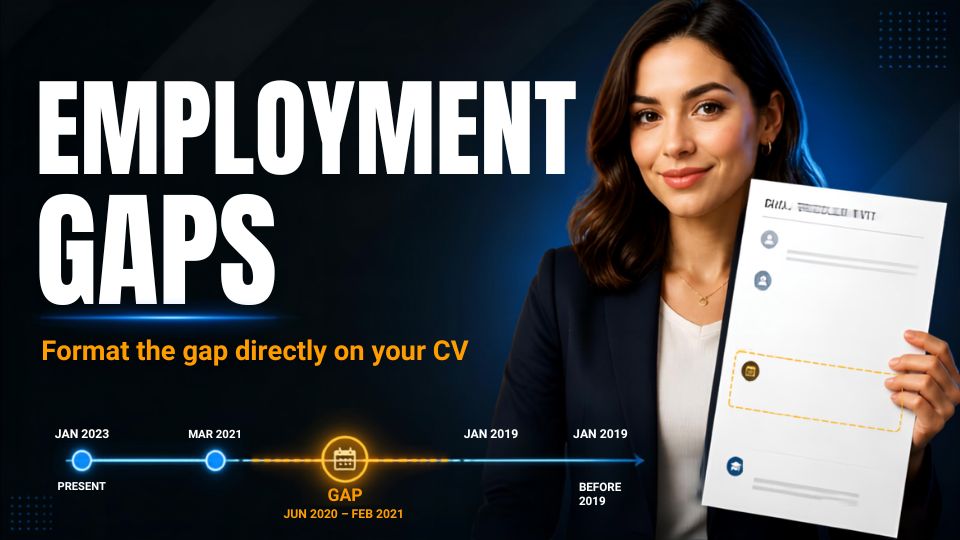
If you decide to address a gap directly, treat it the same way you would treat any other CV entry, with a clear title and a date range, followed by one or two lines describing what the period actually involved.
Career Break, 2022 to 2024 Focused on full-time caregiving for a family member while completing online coursework in project management and data analysis.
Career Pause, 2023 Took a planned break to relocate and complete a professional certification in digital marketing.
Independent Study and Upskilling, 2024 to 2025 Completed an intensive software development bootcamp, building three production-level projects using JavaScript and React.
Notice that none of these examples apologize for the gap or over-explain it. Each one states the period plainly, using a clear label, and immediately pivots to something concrete that happened during that time.
If you genuinely did not do anything formally structured during your gap, such as caregiving without a course attached, or a period of job searching, it is still worth listing it honestly rather than leaving a blank space. A line as simple as “Career Break, 2023 to 2024, Focused on family responsibilities” is far better than an unexplained blank stretch on your timeline, since the blank space tends to invite more assumption and more concern than a brief, honest entry.
Choosing the Right CV Format
If your gap sits alongside a genuine career change, or if you want your skills to carry more weight than a strict chronological timeline, consider a hybrid or functional CV format instead of a purely chronological one. This structure leads with a skills and competencies section near the top of your CV, before your detailed work history, which allows a reader to see your relevant capabilities clearly before they reach the timeline where your gap appears.
For most candidates with a single, clearly explained gap, a standard chronological format with an honest gap entry works perfectly well. A hybrid format becomes more useful specifically when you have multiple gaps, a significant career pivot, or when your most relevant experience is not your most recent experience chronologically.
If you want a properly structured starting point for either format, a set of resume templates built around clean, ATS-friendly layouts makes it easier to apply either approach without wrestling with formatting from scratch.
Turning the Gap Period Into Real Content
Whatever caused your gap, look honestly at what you actually did during that time, since far more of it counts as legitimate CV content than most people initially assume. Freelance or contract work, volunteering, formal caregiving responsibilities, a course or certification, and even structured personal projects all belong on your CV, described the same way you would describe a paid role.
A useful habit here is upgrading the language you use to describe informal responsibilities so they read with the same weight as formal work experience. Instead of writing “Helped with scheduling appointments,” write “Managed scheduling and communication for a family care arrangement, coordinating multiple providers and reducing conflicts.” The underlying activity is the same. The second version simply describes it with the same specificity and professional framing you would use for any paid role.
If your gap involved structured learning, list it clearly with real detail rather than a vague mention.
Full-Stack Software Engineering Program, January 2024 to August 2024 Completed over 700 hours of instruction in JavaScript, React, and backend development. Built three production-grade applications, including a deployed real-time collaboration tool.
Explaining Specific Types of Gaps
Layoff or redundancy. This requires no defensiveness at all. State it plainly, since layoffs are now widely understood as a normal, often unavoidable part of many industries’ recent history, unrelated to individual performance.
Caregiving. Frame the specific responsibilities and skills involved, such as coordination, budgeting, or crisis management, the same way you would frame any other significant responsibility.
Health-related gaps. You are not obligated to share specific medical details on your CV or in an interview. A brief, general line such as “Career Break, 2023, Took time to focus on a health matter” is sufficient, and you can keep further detail private unless you choose to share more.
Further study or upskilling. This is one of the easiest gaps to explain, since it demonstrates initiative directly. Lead with what you learned and what you built or produced during the program.
Career change or pivot. If you left one field and took time to reposition into another, a hybrid CV format leading with transferable skills, paired with a brief note about the transition, works well. A short professional summary line such as “Marketing professional transitioning into product management, having completed a certification in product strategy” can frame this clearly at the top of your CV.
What to Say in the Interview
Your CV entry only needs to be brief. The fuller explanation belongs in the interview itself, and a simple three-part structure works well for almost any gap. State the context briefly, describe what you did during that time, and close by explaining why you are ready now. This keeps your answer honest and confident without turning into a long, uncomfortable justification.
If you were let go for performance reasons rather than a layoff, avoid overexplaining or badmouthing a previous employer. A brief, honest line such as “The role and I were not the right fit, and I have since focused on strengthening that specific area” works better than a defensive or lengthy explanation. Never misrepresent the reason for a gap or a termination, since background checks and reference calls frequently surface the real story, and being caught in a misrepresentation damages your credibility far more than an honest gap ever would.
Does an ATS Penalize Employment Gaps
No. Applicant Tracking Systems parse keywords, dates, and formatting, but they do not calculate or score the length of a gap in your timeline. A gap is something a human reviewer evaluates, not something the software itself flags. This means your focus for gap-proofing your CV should be on clear, honest framing for the human reader, while keeping your date formatting consistent and your overall structure clean so the ATS parses the rest of your CV correctly.
Common Mistakes to Avoid
Leaving the gap completely blank with no entry at all. An unexplained blank stretch tends to draw more concern than a brief, honest line addressing it directly.
Over-explaining or apologizing at length. A gap entry should be brief and confident, not a long justification that draws even more attention to itself.
Lying about the reason or the dates. Misrepresenting a gap is far riskier than being honest about it, since it can surface later through references or background checks and damages your credibility far more than the original gap ever would.
Describing gap-period activity too vaguely. If you did meaningful work during your gap, whether formal or informal, describe it with the same specificity and professional language you would use for a paid role.
Assuming every employer weighs gaps the same way. Attitudes have shifted significantly, but not universally. Prepare a clear, confident answer regardless of how understanding you expect a specific employer to be.
Frequently Asked Questions
Do I need to explain every gap on my CV? No. Short gaps of a few months generally need no explanation at all, and can often be smoothed over simply by listing years rather than specific months on your timeline. Gaps of six months or longer are usually worth addressing directly.
What should I write for a gap with no formal activity attached? Be honest and brief. A simple entry such as “Career Break, 2023 to 2024, Focused on personal and family responsibilities” is far better than leaving the period unexplained.
Will an Applicant Tracking System reject my CV because of a gap? No. ATS software parses keywords and formatting, not the length of gaps in your timeline. Gaps are evaluated by a human reader, not the automated system.
Should I mention a health-related gap in detail? No. You are not obligated to share specific medical details. A brief, general statement is sufficient, and you can choose to share more only if you are comfortable doing so.
Is it better to use a chronological or functional CV format if I have a gap? A standard chronological format with an honest gap entry works well for most candidates. A hybrid or functional format, which leads with skills before your detailed timeline, becomes more useful if you have multiple gaps or a significant career change.
What if I was let go for performance reasons rather than laid off? Keep your explanation brief and honest without being defensive. A short line acknowledging the fit was not right, followed by what you have done since to address it, works better than a lengthy justification.