A comparison of Cameroon's GCE and Baccalaureat systems, how each is recognized abroad, and how the bilingual advantage can matter more than which exam you sat. Cameroon is one of the only countries in Africa running two full, parallel secondary education systems side by side. The Anglophone GCE system and the Francophone Baccalaureat system are …
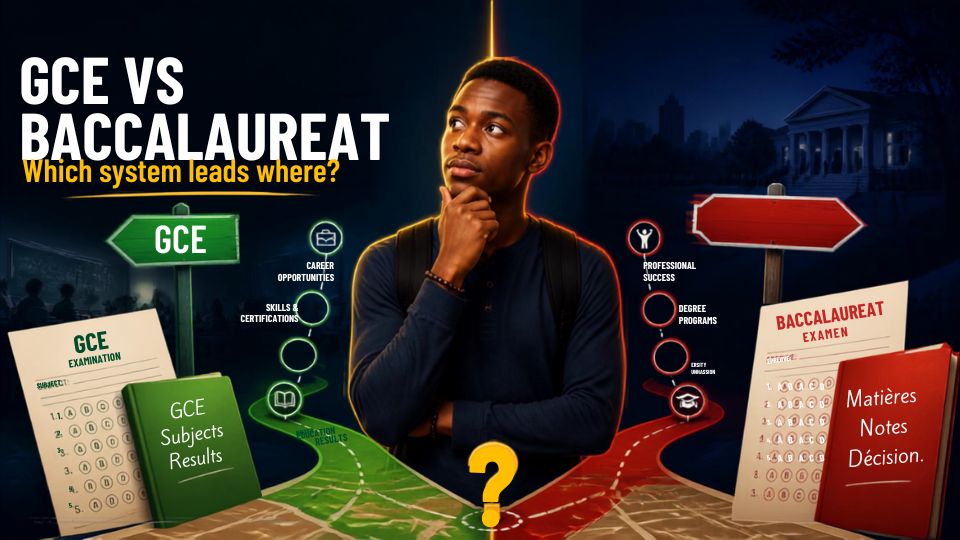
A comparison of Cameroon’s GCE and Baccalaureat systems, how each is recognized abroad, and how the bilingual advantage can matter more than which exam you sat.
Cameroon is one of the only countries in Africa running two full, parallel secondary education systems side by side. The Anglophone GCE system and the Francophone Baccalaureat system are both government-recognized, both lead to public university admission, and both are taken seriously by employers and institutions across the country. Yet almost nobody has written a clear, direct comparison of the two, which leaves parents choosing a system for a child, and even students questioning which path serves them best, without a real answer.
This guide breaks down how the two systems actually differ, where each one gives you an advantage, and how to think about the choice if you genuinely have one.
Table of Contents
ToggleThe two systems, briefly
The GCE system follows the British-style structure familiar across much of Anglophone Africa. Students in Cameroon typically sit the GCE Ordinary Level in Form 5, following a course that runs from Form 3 through Form 5, and later sit the GCE Advanced Level in Upper Sixth for those continuing into the science, arts, or commercial streams. The exam is administered by the Cameroon GCE Board, based in Buea, and results are graded on a letter scale similar to what students in Nigeria and Ghana would recognize from WAEC.
The Baccalaureat system follows the French academic model, administered by the Office du Baccalaureat du Cameroun, known as OBC. Students progress through the Francophone secondary system toward the Baccalaureat exam at the end of Terminale, the final year of lycee, often after passing an intermediate exam called the Probatoire in the preceding year. The Baccalaureat is graded on a 20-point scale, a structure inherited directly from the French education system and shared with francophone countries across West and Central Africa.
Both systems run under Cameroon’s Ministry of Secondary Education, and both are formally equivalent for the purpose of public university admission within Cameroon itself. The real differences show up not in whether one is “better,” but in where each system opens doors more easily.
Grading structure: a genuinely different logic
This is the part that trips up most comparisons, because a direct grade-for-grade conversion between the two systems does not exist in any officially recognized way.
GCE grading runs on a letter scale, with Ordinary Level typically graded A to F and Advanced Level often using a similar or expanded scale depending on the subject. A student’s overall standing is usually described in terms of how many subjects were passed at credit level or above, similar to how WAEC and NECO results are read in Nigeria and Ghana.
The Baccalaureat uses a 20-point numerical average, where a student’s final mark is a weighted combination of scores across their subject combination, known as a “serie,” such as literary, scientific, or economics and social sciences streams. A mark of 10 out of 20 is generally the pass threshold, with distinctions awarded at higher averages, following the same structure used in the original French Baccalaureat.
Because the underlying logic of the two systems is different, a strong GCE result and a strong Baccalaureat result cannot be lined up next to each other and compared directly. What matters far more is what each qualification is recognized for, and where.
Where GCE gives you an advantage
If your goal involves English-speaking academic or professional environments, the GCE system carries real, practical weight.
Anglophone and international university admission. GCE Advanced Level results are widely recognized by universities in English-speaking countries, including the UK, several universities in Nigeria and Ghana, and many international programmes that specifically request GCE A Level or an equivalent as an entry requirement. If you are aiming for study outside Cameroon in an English-medium system, GCE is generally the more directly transferable qualification.
English-language professional environments. Many international NGOs, multinational companies, and English-medium employers operating in Cameroon and across Anglophone Africa are simply more familiar with reading and evaluating GCE results, since the format mirrors what they already understand from Nigeria, Ghana, and other Commonwealth education systems.
Regional Anglophone mobility. If you intend to study or work in Nigeria, Ghana, or other English-speaking African countries, a GCE background aligns naturally with the WAEC and similar systems those countries already use, reducing friction in how your qualification is understood by admissions officers or employers there.
Where the Baccalaureat gives you an advantage
If your future is oriented toward Francophone institutions, France itself, or francophone regional opportunities, the Baccalaureat holds a distinct edge.
Direct recognition in France and Francophone countries. As the same qualification structure used across France and much of Francophone West and Central Africa, the Baccalaureat is directly and immediately recognized by French universities and grandes ecoles, without requiring the kind of equivalence assessment that a GCE certificate might need when presented to a French institution.
Francophone regional and diplomatic opportunities. Cameroon’s Francophone-administered civil service, many regional Central African institutions, and francophone-oriented scholarship and exchange programmes tend to favor the Baccalaureat as the expected qualification, simply because it matches the administrative and academic language used in those spaces.
DAAD and European francophone-track scholarships. Some scholarship programmes, including certain DAAD tracks aimed at francophone African applicants, are structured with francophone secondary education and eventual university study in mind, which can make a Baccalaureat background a more natural fit for those specific funding streams.
The bilingual advantage almost nobody talks about
Here is the detail most comparisons completely miss. Because Cameroon is officially bilingual, a student who is genuinely fluent and strong in both English and French, regardless of which formal exam system they sat, holds a real, practical advantage over applicants from purely Anglophone or purely Francophone countries competing for the same regional or international opportunities.
Scholarship committees and international employers increasingly value candidates who can operate comfortably in both language environments, particularly for regional roles spanning both Anglophone and Francophone Africa. If you sat GCE but are also strong in French, or sat the Baccalaureat but write and speak confidently in English, this is worth stating clearly and specifically on your CV and in any application, since it is a genuine differentiator most competing applicants simply cannot claim.
So which system should you choose, if you have a choice
For most families, the honest answer is that the choice is usually made by which system your region and available schools offer, rather than a free decision between two equally available options. But if you genuinely are choosing, here is a simple way to think about it.
Choose GCE if your medium to long-term goal clearly points toward English-medium university study, work with international or English-speaking employers, or eventual movement toward Nigeria, Ghana, or English-speaking countries beyond Africa.
Choose the Baccalaureat if your goal is study in France or a francophone European country, a career within Cameroon’s Francophone-administered institutions, or opportunities tied closely to francophone regional and diplomatic networks.
If neither goal is fixed yet, and both systems are genuinely available to you, the strongest long-term position is functional strength in both languages regardless of which formal exam system you sit, since that bilingual capability is what actually opens the widest range of doors later.
After your results, whichever system you sat
Whether you hold a GCE certificate, a Baccalaureat, or both, the practical next steps look similar: applying to university, exploring a scholarship, or beginning your first serious job or internship search. Every one of those paths eventually asks for the same two documents, a CV and, often, a motivation letter or cover letter, regardless of which secondary system produced your results.
CVStudio’s resume templates give you a clean, professional CV structure that works whether you are applying within Cameroon, to a Francophone institution, or to an English-medium university or employer elsewhere. When describing your academic background, language ability, or any leadership and extracurricular experience, CVStudio’s 200 resume skills and abilities examples is a useful reference for finding precise, professional wording. If you are applying for a scholarship or role that expects a personal statement, a cover letter template gives you a clear structure to build from.
For official information on each system, the Cameroon GCE Board publishes results and examination information on its own platform, and Ministry of Secondary Education announcements cover both the GCE and Baccalaureat calendars each year. For French university recognition specifically, Campus France is the official resource for understanding how the Baccalaureat and other qualifications are evaluated for study in France.
Frequently asked questions
Can I sit both GCE and the Baccalaureat? This is uncommon and generally not how Cameroon’s dual system is structured, since students are typically enrolled in either the Anglophone or Francophone secondary stream from an early stage, which determines which exam they eventually sit.
Is one system considered more difficult than the other? Difficulty comparisons between the two are not meaningful in any official sense, since they test different curricula using entirely different grading logic. Neither Cameroonian universities nor most employers treat one as inherently harder or more prestigious than the other.
Does a Baccalaureat automatically transfer to a French university without any extra steps? Generally yes, since it is the same qualification structure used in France itself, though specific programmes may still have their own admission requirements beyond the Baccalaureat result itself.
Will a GCE certificate be accepted at a Francophone Cameroonian university, or vice versa? Both qualifications are recognized for public university admission within Cameroon regardless of which system a specific university primarily operates in, though always confirm current admission requirements directly with your target institution.
Does being bilingual actually help if I only sat one of the two exam systems? Yes. Language ability in both English and French is a separate, valuable asset from which formal exam system you sat, and is worth highlighting clearly in any application, scholarship, or job search regardless of your certificate.
Neither system is objectively better than the other. Each opens a different set of doors more easily, and the strongest long-term position, whenever it is genuinely achievable, is fluency across both languages rather than loyalty to just one system.

Brielle Kensington
Brielle Kensington is a career author and professional resume writer known for helping job seekers turn their experience into powerful personal stories. With a strong background in career development and modern hiring trends, she has helped hundreds of professionals craft resumes that stand out and get interviews.
Brielle specializes in writing clear, results-focused resumes, compelling cover letters, and LinkedIn profiles that attract recruiters. Her writing style is polished, strategic, and tailored to each client’s career goals. Through her books and career guides, she teaches simple but powerful strategies that help professionals confidently navigate today’s job market.
She believes every professional has a unique story, and the right words can open the right doors.