How Cameroonian students can apply for DAAD scholarships in Germany or Africa, including EPOS, regional funding, eligibility, deadlines, and a step-by-step application guide. DAAD Scholarships for Cameroonian Students: The Complete 2026/2027 Application Guide Germany funds more international students than almost any other country in the world, and Cameroon sits in an unusually strong position to …
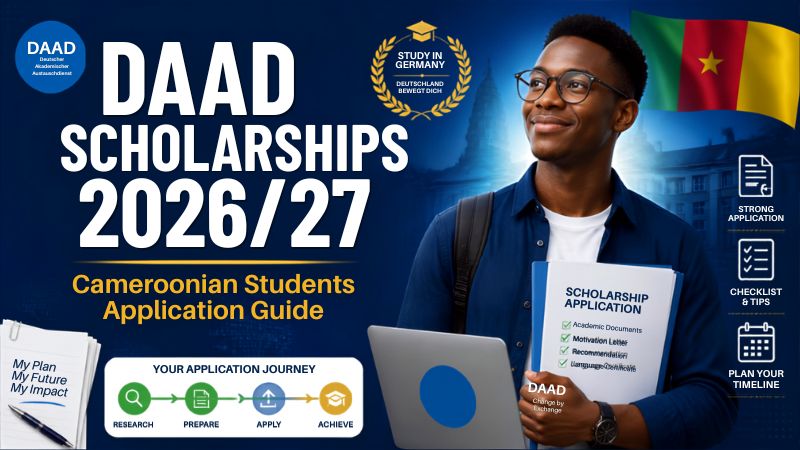
How Cameroonian students can apply for DAAD scholarships in Germany or Africa, including EPOS, regional funding, eligibility, deadlines, and a step-by-step application guide.
DAAD Scholarships for Cameroonian Students: The Complete 2026/2027 Application Guide
Germany funds more international students than almost any other country in the world, and Cameroon sits in an unusually strong position to benefit from it. The German Academic Exchange Service, known as DAAD, runs an Information Centre directly in Cameroon, treats the country as a genuine funding priority across dozens of its scholarship programmes, and even runs an In-Country/In-Region track that lets Cameroonian students study fully funded without leaving the African continent at all.
Most guides written for Cameroonian applicants simply copy a generic “DAAD scholarship” article and swap the country name. This one focuses specifically on what actually applies to you as a Cameroonian student, including the bilingual advantage almost nobody talks about.
Why Cameroon has a real edge with DAAD
Cameroon is one of the countries where DAAD maintains a direct physical presence, an Information Centre based in Yaounde, which means you can get direct answers about admission conditions and available scholarships rather than relying entirely on online forums and outdated blog posts. DAAD also regularly participates in Cameroonian education fairs, including the PROMOTE exhibition in Yaounde, where their team meets prospective applicants face to face.
There is also a structural advantage tied to language. Because Cameroon is officially bilingual, French and English, Cameroonian applicants can realistically approach both German university admissions in English-taught programmes and the substantial number of DAAD-linked opportunities that favor Francophone African applicants, particularly through EPOS and regional development programmes that explicitly list Francophone and Central African countries as priority nationalities. Most competing applicants from purely Anglophone or purely Francophone countries do not have this flexibility. If you are a strong writer in both languages, this is worth highlighting directly in your application materials.

The three main routes into a DAAD scholarship
1. Study in Germany directly (EPOS and general scholarship database)
This is the classic DAAD route: a fully funded Master’s or PhD programme in Germany. EPOS, which funds development-related postgraduate courses, is specifically designed for applicants from developing countries and explicitly includes Cameroon on its eligible nationality list. These programmes typically cover a monthly stipend starting around 1,300 euros, health insurance, travel costs, and in many cases a research or study allowance.
For the 2027 intake, the general pattern has applications opening in May and closing around 15 October 2026 for scholarships that begin the following October, though exact deadlines vary by individual programme, so always confirm the specific date on the DAAD scholarship database rather than assuming a fixed calendar. DAAD also does not fund applicants who will have already spent more than 15 months in Germany by the time the scholarship begins, so this route is aimed squarely at students still based in Cameroon or elsewhere outside Germany.
2. Study in Germany through a subject-specific regional scholarship
Separate from EPOS, DAAD runs targeted regional scholarships that name Cameroon directly. One notable example is the West and Central Africa scholarship track, which is specifically open to highly qualified graduates from Cameroon, Senegal, and Togo for tuition-free Master’s programmes in Germany starting in the winter term. These programmes typically include a language course of up to six months in Germany before the academic programme begins, which is particularly useful if your German is currently weak.
3. Study in Africa through the In-Country/In-Region programme
This is the option most Cameroonian students overlook, and it is arguably the most practical for many applicants. The DAAD In-Country/In-Region programme funds Master’s and PhD study at strong universities within Sub-Saharan Africa itself, not in Germany. Cameroon is both an eligible applicant country and a host country under this scheme, meaning you can either study at a participating Cameroonian institution such as the University of Dschang, which currently has DAAD-funded PhD tracks in Parasitology and Pharmacology, or use your Cameroonian eligibility to apply to funded programmes in Ghana, Kenya, Nigeria, South Africa, and other participating countries.
This route matters because it removes several of the biggest barriers to studying abroad: visa complexity, cost of living in Europe, and the language requirement, while still delivering full funding, a real scholarship credential, and postgraduate-level education.
General eligibility conditions across most DAAD programmes
Requirements vary by specific programme, but these conditions come up repeatedly across nearly all DAAD scholarships open to Cameroonian applicants.

- Your most recent degree should generally have been completed within the last six years of the application deadline
- You need a strong academic record, typically evidenced by your transcripts and degree certificate
- Most programmes require proof of language ability, either German or English depending on the programme, with English-taught tracks becoming increasingly common
- A motivation letter and a detailed, well-structured CV are required for essentially every DAAD scholarship application, and these two documents are often what separates similarly qualified candidates
- Letters of recommendation from academic referees, usually two
Where Cameroonian applicants lose points, and how to avoid it
Having reviewed how these applications are commonly evaluated, a few recurring weaknesses show up specifically in West and Central African applications.
A generic motivation letter. DAAD reviewers read thousands of these. A letter that could apply to any scholarship, from any applicant, in any country, gets set aside quickly. Your motivation letter needs to explain specifically why this programme, why Germany or the specific African host institution, and how your background connects to what you want to study next. Vague statements about “wanting to contribute to development” without a concrete example carry little weight.
A CV that reads like a list rather than a story of growth. DAAD assessors are looking for a clear academic and professional trajectory, not just a list of qualifications. Your CV should show progression, relevant coursework, any research experience, and any leadership or community involvement that connects to your intended field of study.
Missing the language flexibility angle entirely. If you are genuinely comfortable in both English and French, say so clearly and specifically in your application. This is a real, verifiable strength for regional programmes and for any role connecting German, Francophone, and Anglophone African institutions.
Applying too close to the deadline. DAAD’s application portal experiences heavy traffic in the final days before major deadlines, and technical delays at that point are common. Submitting at least two weeks before the deadline gives you room to fix any last-minute document issue without losing your application entirely.
Step by step: how to actually apply
- Visit the DAAD scholarship database at daad.de and filter by your country, Cameroon, and your intended degree level, to see every currently open programme you are eligible for
- Also check the DAAD Cameroon Information Centre directly at daad.cm for country-specific announcements, fairs, and programmes with a Cameroon-specific quota
- Shortlist two or three programmes that genuinely match your academic background rather than applying broadly to everything, since a targeted, well-written application beats several rushed ones
- Gather your documents early: transcripts, degree certificate, language certification, two recommendation letters, and your CV and motivation letter
- Write your motivation letter and CV specifically for each individual programme rather than reusing one generic version
- Submit through the individual university or programme’s designated application platform, since DAAD funding is usually tied to a specific university admission process, not a single central application
- Submit at least two weeks ahead of the deadline to allow time for any technical issue

Your CV and motivation letter are not optional extras
Because nearly every DAAD track requires both a CV and a motivation letter, and because these two documents genuinely decide close calls between applicants, it is worth treating them as seriously as your academic transcripts. If you are putting your CV together for the first time or reworking an old one, CVStudio’s resume templates give you a clean, professional structure that reads well to an international scholarship committee, not just a local employer. When you list out your academic and extracurricular strengths, CVStudio’s 200 resume skills and abilities examples is useful for finding precise, professional wording instead of vague filler phrases.
For the motivation letter itself, since DAAD calls it a letter rather than an essay, structuring it the way you would a strong cover letter works well: a clear opening about who you are and what you want to study, a middle section connecting your background to the specific programme, and a closing that states what you intend to do with the qualification afterward.
Frequently asked questions
Can I apply for a DAAD scholarship to study in Germany without knowing German? Yes, many programmes are taught fully in English, and some scholarships, particularly those with a language course component, are specifically designed to bring your German up to speed before your academic programme begins.
Is the In-Country/In-Region scholarship less prestigious than studying in Germany? No. It is a legitimate DAAD-funded, fully recognized scholarship, and for many students it offers a more practical path to full funding without the added cost and visa complexity of relocating to Europe.
How many DAAD scholarships can I apply for at once? There is no fixed rule against applying to more than one, but each application needs a genuinely tailored motivation letter and CV, so quality matters far more than quantity.
Does DAAD only fund graduate study? DAAD’s scholarship portfolio is heavily weighted toward Master’s and PhD study, along with research stays and short courses, so most opportunities for Cameroonian applicants are at postgraduate level.
What happens if I miss a specific programme’s deadline? DAAD runs multiple funding cycles and dozens of individual programmes throughout the year, so missing one deadline does not mean waiting a full year. Check the scholarship database regularly, since new calls open at different points across the year.
A DAAD scholarship is genuinely within reach for a well-prepared Cameroonian applicant, and your bilingual background is a real advantage most competing applicants simply do not have. The students who succeed are rarely the ones with the single best transcript in the pool. They are the ones who put together a specific, well-written CV and motivation letter for the exact programme they are applying to, and submitted it early.