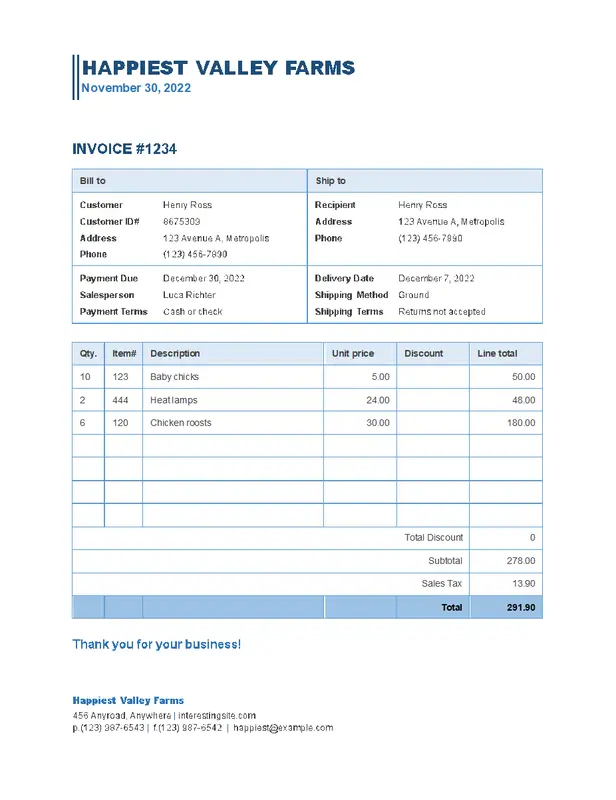
Complete guide to NSFAS funding for 2027 how to apply guide: who qualifies, required certified documents, application steps, and how to avoid the mistakes that cause rejections. NSFAS Application 2027: Complete Guide to Funding, Eligibility, and Required Documents If you are heading into your first year at a South African public university or TVET college …
Complete guide to NSFAS funding for 2027 how to apply guide: who qualifies, required certified documents, application steps, and how to avoid the mistakes that cause rejections.
NSFAS Application 2027: Complete Guide to Funding, Eligibility, and Required Documents
If you are heading into your first year at a South African public university or TVET college in 2027, or you are a returning student needing to reapply, the National Student Financial Aid Scheme is very likely the single most important funding decision in front of you right now. NSFAS applications for the 2027 academic year are expected to open in mid to late September 2026, with a closing date historically falling around 15 November, though NSFAS has changed its exact published dates more than once across recent cycles, so treat any specific date you see, including in this article, as a guide to confirm directly on the official NSFAS website before you rely on it.
This guide walks you through exactly who qualifies, what documents you need ready, and how to avoid the mistakes that get otherwise eligible applications rejected every single cycle.
What NSFAS actually is
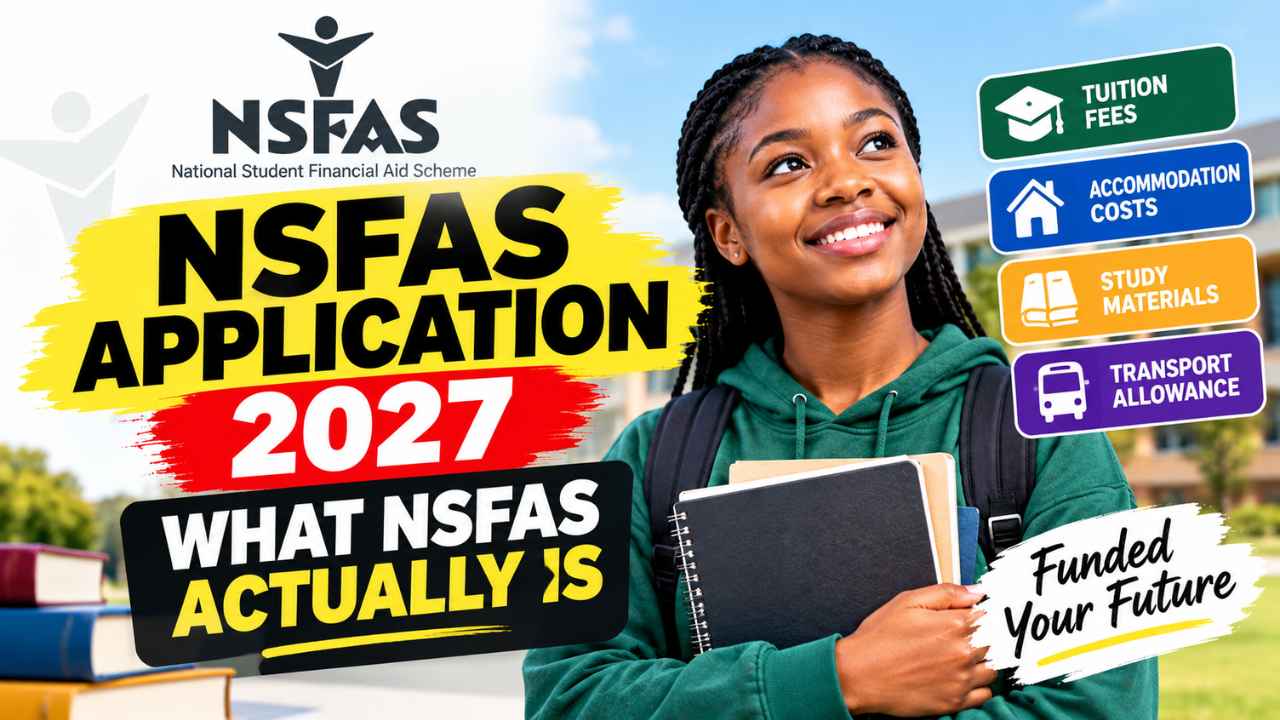
NSFAS provides funding to students in the form of a bursary for undergraduate study, which does not need to be repaid once you complete your studies and secure employment, covering the full duration of your qualification provided you continue to meet the academic progression requirements each year. For the most recent full academic year, NSFAS processed close to 900,000 applications and approved well over 600,000 students for funding, making it by far the largest source of student financial aid in South Africa.
Funding covers tuition fees, and for eligible students also extends to accommodation, transport, and a learning materials allowance, depending on your specific circumstances and institution type.
Who qualifies for NSFAS
The core eligibility rules have stayed broadly consistent across recent cycles, though always verify the current thresholds directly with NSFAS before applying, since these figures are reviewed periodically.
- You must be a South African citizen or permanent resident with a valid ID, since non-citizens and non-permanent-residents are not eligible to apply
- Your combined household income must not exceed R350,000 per year for standard bursary funding
- If you have a registered disability, this income threshold increases to R600,000 per year
- You must be registered, or in the process of registering, at a public university or one of South Africa’s 50 public TVET colleges
- If you receive a SASSA grant, you automatically qualify on the financial eligibility criteria, a route that accounted for a very large share of recent approvals
Note that NSFAS does not fund students seeking a second qualification at the same level they have already completed, and does not fund students who already receive full funding for their studies from another source. If either applies to you, confirm your specific situation with NSFAS directly rather than assuming you are excluded, since some exceptions exist depending on the qualification pathway.
Academic requirements, including for returning students
Getting approved once does not mean your funding continues automatically without conditions. University students under the standard bursary must maintain a course credit pass rate as determined by their specific institution’s academic progression policy, reviewed at the end of each academic year. If you are funded under the separate loan scheme, which applies to certain postgraduate students and those in the R350,001 to R600,000 income bracket, you generally need to maintain a 60 percent pass rate to continue receiving support.
If you were not funded by NSFAS in the immediately preceding academic year and need funding again, you are classified as a returning student and must reapply and meet the standard continuing-student academic eligibility criteria, rather than assuming your earlier funding history carries forward automatically.
Documents to prepare before the portal opens
This is where most delays and rejections actually happen, not because applicants are ineligible, but because documents are missing, expired, or improperly certified. Have the following ready, certified within the last six months at a police station, Post Office, or by a commissioner of oaths:
- Certified copy of your South African ID, or birth certificate if you are under 16
- Certified copies of your parents’ or guardians’ IDs
- Latest payslips for all household wage earners, or a sworn affidavit if a household member is unemployed
- Latest three months of bank statements
- Proof of residence
- A Vulnerable Child Declaration, if applicable to your situation
- A completed Disability Annexure A form, if applying under the disability income threshold
Uncertified or expired certifications are a common and entirely avoidable reason for rejection or delay. Get these documents certified early, well before the portal opens, rather than scrambling once the application window is already ticking.
You will also need a valid, unique email address and cellphone number that you can access consistently throughout the application and funding period, since NSFAS communicates status updates, requests for additional documents, and funding decisions through these channels.
How to apply, step by step
- Go to the official NSFAS website at www.nsfas.org.za and create your myNSFAS account, or log into your existing one if you are a returning applicant
- Complete the online application form with your personal, household, and institutional details
- Upload all required certified documents in the format the portal specifies
- Submit your application well before the stated closing date, since NSFAS has been explicit that late applications are not accepted under any circumstances
- Track your application status regularly through the myNSFAS portal, since decisions and any requests for additional information are communicated there directly
Do not wait passively for an email notification alone. Log in and check your status proactively, particularly in the weeks immediately following the closing date, since a request for a missing document can have its own short response window.
A note on the TVET Trimester 3 window
Separate from the main annual application cycle, NSFAS has previously run a special Trimester 3 application window specifically for TVET college students starting a new term partway through the year. These special windows have their own dates, sometimes announced and then revised, as happened with a recent Trimester 3 cycle where the original September dates were withdrawn and moved earlier. If you are a TVET student applying outside the main annual cycle, always check the current, officially confirmed dates on the NSFAS site directly, and disregard outdated dates you may see circulating on posters or unofficial pages.
Common reasons applications get rejected or delayed
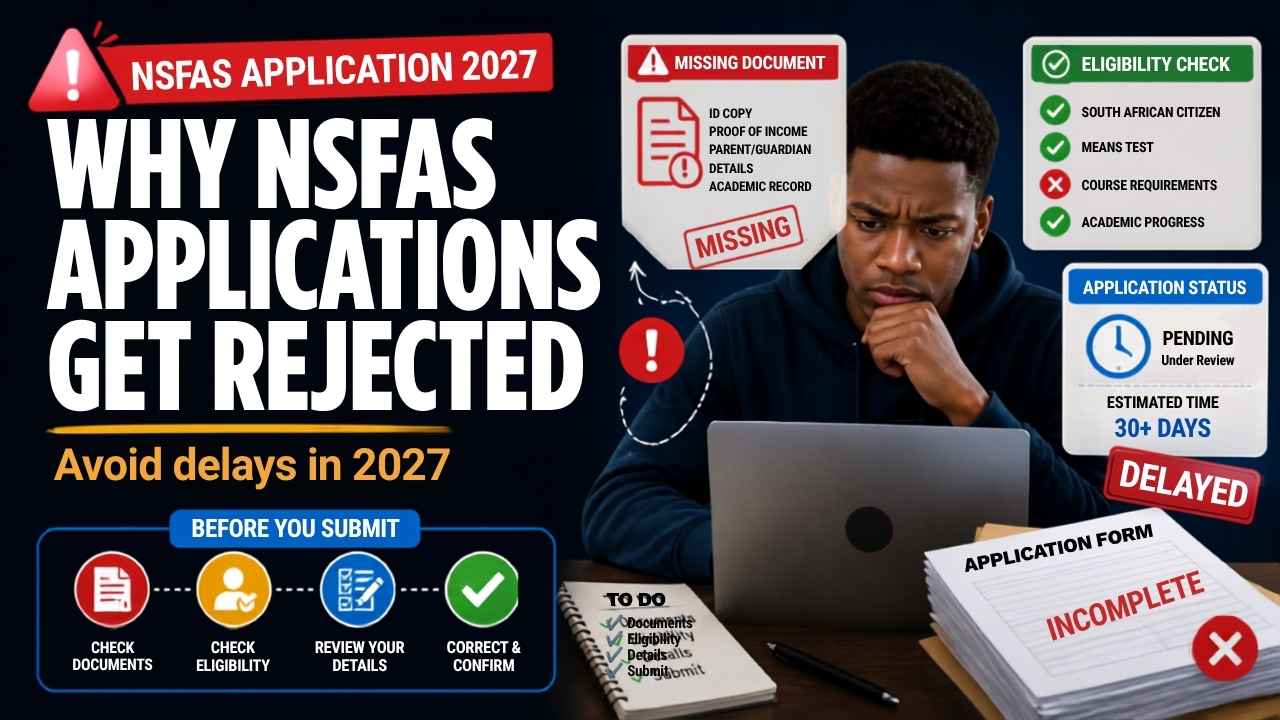
- Uncertified or expired certified documents, particularly IDs and proof of income
- Household income calculated incorrectly, often by omitting a working household member’s income or including only one parent’s payslip when both are required
- Missing the closing date entirely, since NSFAS has stated repeatedly that late applications are not accepted
- Applying for a second undergraduate qualification at the same level as one already completed, without checking whether an exception genuinely applies
- Incomplete disability documentation when applying under the higher income threshold
If your application is rejected, NSFAS provides an appeals process, typically with a defined window of around 30 days from your rejection notice to submit supporting evidence. Do not assume a rejection is final without checking the specific reason given and whether it is something you can address through an appeal.
What happens after you are funded, and what it means for your CV
Once you are registered and funded, your focus shifts to maintaining your academic progression and starting to think about the years ahead, including internships, vacation work, and eventually your first job search. Many NSFAS-funded students are the first in their family to attend university, and it is common to reach final year without ever having built a formal CV, simply because the need never came up until an internship application appeared with a tight deadline.
Start earlier than that. Build a simple, clean CV from your first year, even if it currently lists only your matric results, any school leadership roles, and volunteer work. CVStudio’s resume templates give you a clean, professional structure that reads well to South African employers and internship coordinators. When describing your strengths, especially with limited formal work experience so far, CVStudio’s 200 resume skills and abilities examples is a useful reference for finding accurate, professional wording.
If you apply for a bursary top-up, a vacation work programme, or a graduate internship alongside your NSFAS funding, many of these also expect a short motivation letter or cover letter. A cover letter template makes that process considerably faster than starting from a blank page each time.
Frequently asked questions
When do 2027 NSFAS applications open? Applications are expected to open in mid to late September 2026, though exact dates have shifted between cycles in recent years. Confirm the current opening and closing dates directly on nsfas.org.za before the window you are targeting.
Can international students apply for NSFAS? No. NSFAS funding is restricted to South African citizens and permanent residents with a valid South African ID.
What is the household income limit for NSFAS funding? R350,000 per year for standard funding, rising to R600,000 per year for households with a registered disability.
Do I need to reapply every year even if I was already funded? Returning students who were not funded in the immediately preceding academic year need to reapply and meet the continuing-student academic requirements. Requirements and processes can differ depending on your specific funding history, so check your status directly through myNSFAS.
What happens if my application is rejected? NSFAS typically allows an appeal within a set window, often around 30 days from your rejection notice, provided you submit supporting evidence addressing the specific reason for rejection.
Does NSFAS fund postgraduate study? Postgraduate funding is available through the separate loan scheme for students in the R350,001 to R600,000 income bracket, subject to a 60 percent pass rate and specific conversion conditions, so confirm your eligibility for this track directly with NSFAS.
NSFAS funding decisions come down to two things almost every rejected applicant could have controlled: submitting complete, properly certified documents, and applying well before the closing date rather than in its final days. Get both of those right, and your academic results become the only real variable left to manage.