Placed through KUCCPS in 2026? Here is exactly what to do next: confirming your placement, applying for HELB or HEF funding, handling transfers, and preparing your first CV. What to Do After KUCCPS Placement Results 2026: Your Complete Next Steps Guide The Kenya Universities and Colleges Central Placement Service released the 2026/2027 placement results on …
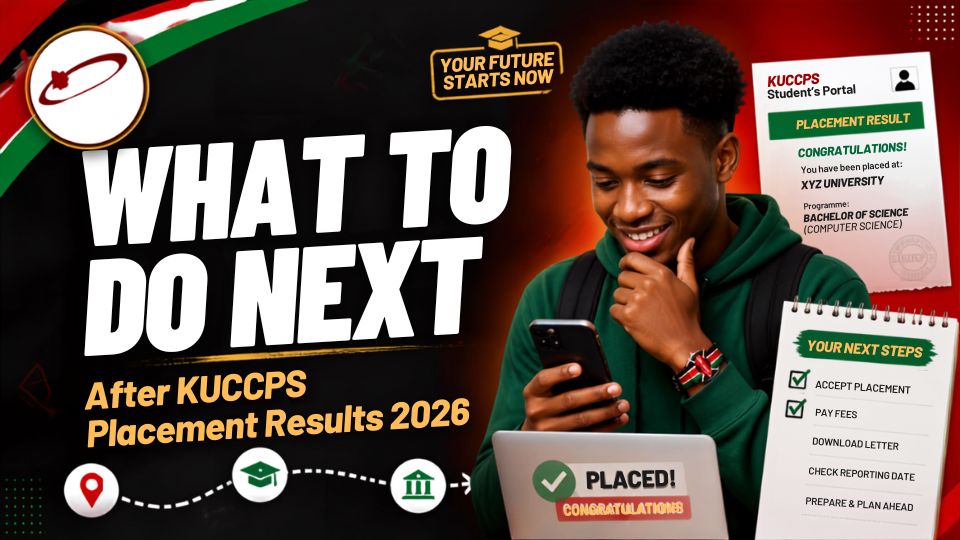
Placed through KUCCPS in 2026? Here is exactly what to do next: confirming your placement, applying for HELB or HEF funding, handling transfers, and preparing your first CV.
Table of Contents
ToggleWhat to Do After KUCCPS Placement Results 2026: Your Complete Next Steps Guide
The Kenya Universities and Colleges Central Placement Service released the 2026/2027 placement results on 8 July 2026. Out of 980,535 candidates who sat the 2025 KCSE examination, more than 270,000 attained the minimum C+ grade needed for degree programme eligibility, and 293,869 students in total were placed across universities, KMTC, Kenya Utalii College, teacher training colleges, and other institutions.
If you are one of them, congratulations, the hard part of studying and sitting the exam is behind you. What comes next, from confirming your placement to securing funding, is just as important and has real deadlines attached. This guide walks you through exactly what to do, in order, so you do not miss a step between now and reporting day.
Step 1: Confirm your placement result
Log in to the KUCCPS Student Portal using your KCSE index number, the examination year (2025), and your password, which is your birth certificate number. Once you log in, your dashboard will show the institution and the specific course you have been placed into.
Read this carefully. It is common for students to skim past the course name and assume they got their first choice when they were actually placed into a related but different programme. Confirm the exact course title, the institution, and the campus, since some universities run the same programme across multiple campuses with different reporting requirements.
If your results are not yet visible when you log in, do not panic. KUCCPS uploads placements in batches, and the agency has said it is developing a mechanism for late applications for students who were eligible but missed the initial window. Keep checking the portal periodically and make sure promotional SMS messages are enabled on your phone, since KUCCPS sends placement notifications directly to the number you registered with.
Step 2: Understand what your placement category means
Not everyone placed this year went into a degree programme, and that is not a bad outcome. Here is a quick breakdown of where the 2026 placements landed.
- Degree programmes: over 200,000 students, requiring a C+ and above
- Kenya Medical Training College (KMTC): around 28,000 students
- Diploma in Law at the Kenya School of Law: 500 students
- Kenya Utalii College: 765 students
- Teacher Training College programmes: 875 students
- Technical and Vocational Education and Training (TVET) institutions: over a million slots available nationally, open to any KCSE grade from A to E
If you were placed into a TVET, diploma, or certificate programme rather than a degree, this is not a lesser path. Kenya’s job market has a real shortage of skilled technical graduates, and TVET certification often leads to faster, more direct employment than a general degree in a saturated field.
Step 3: Download your admission letter
Once your placement is confirmed, your institution will make your official admission letter available, either through the KUCCPS portal or the institution’s own admissions portal, depending on how that particular university or college handles onboarding. Download it as soon as it is available and read the reporting instructions attached to it carefully, since reporting dates, required documents, and orientation schedules vary by institution.
Universities are expecting students to report in September 2026, while TVET admissions run on a rolling basis with intakes that began in May, so if you were placed into a TVET programme, do not assume you have until September. Check your specific reporting date immediately.
Step 4: Apply for HELB or HEF funding right away
This is the step students delay the most, and it is the one with the tightest practical deadline, since funding needs to be processed and disbursed before fees are due.
Kenya’s higher education funding now runs through the Higher Education Financing (HEF) model. Apply through www.hef.co.ke or www.helb.co.ke as soon as your admission letter is available. If you are a first-time applicant, have the following ready before you start, so you are not stopped halfway through the form:
- A valid, active email address
- An active mobile phone number
- Your KCPE and KCSE index numbers, along with the year you sat each exam
- A recent passport-size photo in JPEG, JPG, or PNG format
- Your National ID number if you have one. If you do not yet have a national ID, you can register using your KCSE index number instead
Do not wait for fee deadlines to approach before applying. Funding applications go through a verification stage before money is disbursed, and starting early gives the system time to process your file without last-minute stress.
If you were placed in a private university, note that not every private institution qualifies for HELB funding. Only institutions on the approved list, currently 31 private universities, are eligible, so confirm your institution’s status on the HELB or HEF site before assuming you qualify.
Separately from HELB, if you were placed into one of the public universities on the KUCCPS government scholarship list, such as University of Nairobi, Kenyatta University, Chuka University, or Rongo University, you may also be eligible for a government scholarship allocation on top of, or instead of, a loan. This is allocated through the Universities Fund and released to institutions in phases, so check with your university’s financial aid office directly once you report.
Step 5: If you missed your first choice, know your options
Not every student gets their first choice institution or course, and that is a normal outcome of a competitive placement system. If this happened to you, you generally have two options.
First, you can request an inter-institution or programme transfer through KUCCPS, though be aware that students who have already secured placement are sometimes temporarily locked out of the revision portal to prevent last-minute course switching after slots have been finalized. Timing matters here, so act as soon as the transfer window opens rather than waiting.
Second, you can accept the placement you received and plan your next move from within that programme. Many students switch programmes internally after their first year once they have proven themselves academically, which can sometimes be a smoother path than fighting for a transfer before you have even started.
Step 6: Start building your student CV before you even resume
This is easy to skip when you are focused on admission logistics, but it matters more than most first-year students realize. From your very first semester, you will likely be applying for things that require a CV: attachment placements, part-time campus jobs, leadership positions in student organizations, internships, and eventually your first job before you have even graduated. Waiting until third year to put together your first CV means starting from zero at the exact moment you need to move fast.
Build a simple, clean CV now, even with limited experience. List your KCSE results, any leadership roles you held in secondary school, volunteer work, and any skills you already have. You can put one together quickly using CVStudio’s resume templates, and if you list out your strengths for the first time, their resume skills and abilities examples is a useful reference for how to phrase what you bring to the table, even without formal work experience yet.
If you are applying for any scholarship on top of your HELB funding, such as a Mastercard Foundation award or a county bursary, most of these require a short personal statement or motivation letter alongside your application. A well written cover letter template makes that process faster and helps you avoid the generic, forgettable letters that get overlooked.
Frequently asked questions
I cannot see my placement result. What should I do? Keep checking the KUCCPS portal, since results are released in batches. Make sure your phone can receive promotional SMS messages, and confirm you are entering your correct KCSE index number, exam year, and birth certificate number.
Can I apply for HELB before I have my admission letter? You need your admission details as part of the HELB or HEF application, so download your admission letter first, then apply for funding immediately after.
What if my chosen private university is not on the HELB approved list? You may not be eligible for HELB funding at that institution. Confirm your university’s status directly on the HELB or HEF website before assuming coverage.
I was placed into a TVET programme instead of a degree course. Is that a bad outcome? No. TVET certification leads directly into skilled employment in many fields and often has less competition and faster job placement than an oversubscribed degree programme.
How do I change my course after placement? Apply for a transfer through the KUCCPS portal as soon as the revision window opens. Once placement is finalized, some students are temporarily locked out of making changes, so act quickly.
Your placement result is the starting line, not the finish line. The students who get ahead over the next four years are usually the ones who treat the first few weeks, admission letter, funding application, and reporting date, as seriously as they treated exam preparation itself.

Brielle Kensington
Brielle Kensington is a career author and professional resume writer known for helping job seekers turn their experience into powerful personal stories. With a strong background in career development and modern hiring trends, she has helped hundreds of professionals craft resumes that stand out and get interviews.
Brielle specializes in writing clear, results-focused resumes, compelling cover letters, and LinkedIn profiles that attract recruiters. Her writing style is polished, strategic, and tailored to each client’s career goals. Through her books and career guides, she teaches simple but powerful strategies that help professionals confidently navigate today’s job market.
She believes every professional has a unique story, and the right words can open the right doors.