DAAD EPOS scholarship deadlines for 2027/28 are closing now. See who qualifies, which documents you need, and how African applicants can apply course by course. DAAD EPOS Scholarship 2027/2028: Deadlines, Eligibility, and How to Apply From Africa If you are a young professional in Africa thinking about a fully funded master's degree in Germany, one …
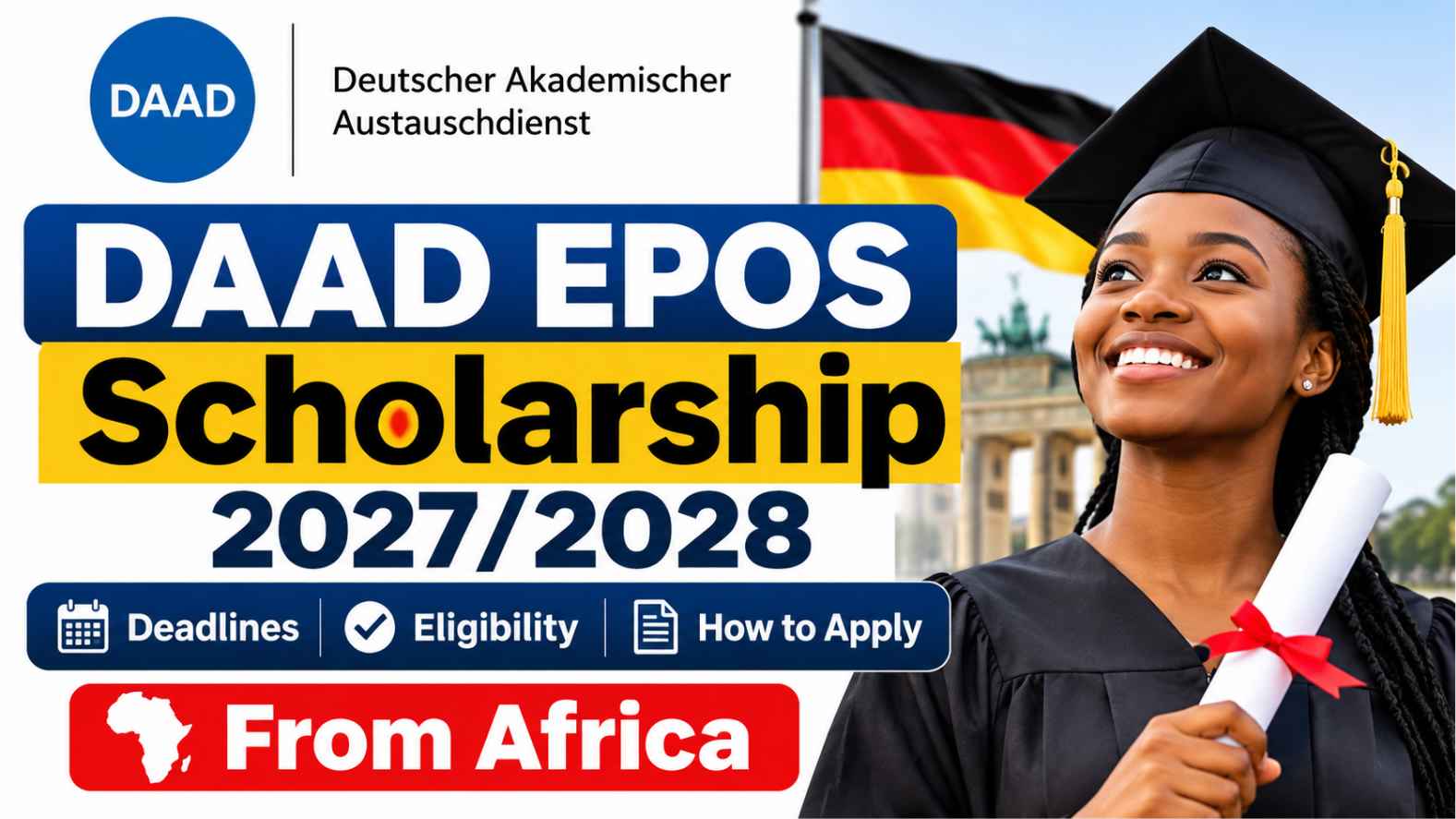
DAAD EPOS scholarship deadlines for 2027/28 are closing now. See who qualifies, which documents you need, and how African applicants can apply course by course.
DAAD EPOS Scholarship 2027/2028: Deadlines, Eligibility, and How to Apply From Africa
If you are a young professional in Africa thinking about a fully funded master’s degree in Germany, one scholarship deserves your attention right now. The DAAD EPOS programme funds development-related postgraduate courses at German universities, and many of its 2027/2028 application windows are closing in the next few weeks.
This guide explains what EPOS is, who can apply, what the scholarship pays, how the deadlines actually work, and how to put together an application that is complete and clear. It is written for applicants from Nigeria, Kenya, Ghana, Cameroon, and the rest of Africa, since almost every African country is on the eligible list.
What EPOS Is
DAAD is the German Academic Exchange Service, the main organisation that funds international students in Germany. EPOS stands for Development-Related Postgraduate Courses. It is the DAAD route built for professionals from developing countries who already work in a field that connects to development, and who want a specialised master’s degree to move further in that field.
EPOS supports about two dozen master’s courses, and in some cases doctoral study, at German universities. The subjects are practical and tied to real development problems, such as engineering, economics, public health, environment, governance, urban planning, and renewable energy. Examples from the 2027/2028 intake include development economics at the University of Goettingen, development management at Ruhr University Bochum, hydro science and engineering at TU Dresden, and sustainable energy and development at the University of Flensburg.

The Most Important Thing to Understand About the Deadlines
EPOS does not have one deadline. Every course sets its own closing date, and you apply directly to the course, not to a central DAAD portal that covers everything.
The scholarship also works a full year ahead. You apply in autumn 2026 for a course that starts in October 2027. That surprises many applicants who expect to apply a few months before the course begins.
Here is what the current cycle looks like, based on what is published for 2027/2028:
The MSc Environmental Governance programme set a deadline of October 15, 2026, which has already passed.
The Goettingen programme in development economics runs an application period from October 1 to November 15, 2026.
TU Darmstadt’s TropHEE programme lists a deadline of November 30, 2026.
Some other courses close in December, and a few are listed with later dates, so check each one.
Because these dates differ and can change, treat every date in this article as a guide and confirm the exact closing date on the official DAAD course list at daad.de and on the course’s own website before you plan anything. If a course you like has already closed this year, do not give up. Most EPOS courses run again every year, and you can use the next few months to prepare a stronger application for the next cycle.
Who Can Apply
The rules are strict, and applications that miss even one requirement are usually rejected without a detailed review. You generally need all of the following:
You are a national of a country on the DAAD list of eligible developing and newly industrialised countries. Most African countries are included.
You hold a first university degree that is no more than six years old at the time you apply, and your results are above average, usually in the upper third of your class.
You have at least two years of relevant professional experience after that degree. This experience should be in development-related work, for example in a public authority, a company, or an organisation where you helped plan or carry out projects. Internships and volunteer work are not accepted as the required experience. Teaching or research inside a university also does not count in most cases, apart from rare exceptions.
You have not lived in Germany for more than 15 months before the application deadline.
You can show that your motivation is linked to development and that you plan to use what you learn to contribute in your home country.
If you already hold a master’s degree, you must explain clearly why a second postgraduate degree is justified and why it deserves funding.
Read that list against your own situation before you spend time on anything else. If your degree is seven years old, or your two years of experience are all internships, EPOS is not the right scholarship for you this year, and it is better to know that early.
What the Scholarship Pays
EPOS is a full scholarship. Based on current published figures, master’s students receive 992 euros per month. Doctoral candidates receive a higher monthly amount, with sources listing figures between 1,300 and 1,400 euros, so confirm the current rate with DAAD. On top of the monthly payment, the scholarship contributes to health, accident, and liability insurance, and it can include travel support and a study and research allowance.
Funding periods vary by course. Master’s programmes under EPOS typically run from 12 up to 42 months, and many include a German language course before the degree starts. Check the course page, because some programmes expect you to start learning German early.
A Note on DAAD Funding Changes
DAAD has announced cutbacks to some of its programmes, including the discontinuation of several schemes and a reduction in the total number of scholarships it awards each year. EPOS is still running for 2027/2028, but competition is high and getting tougher. This is another reason to submit a clean, complete application and to apply to up to three courses rather than only one.
The In-Country and In-Region scholarship, which funds master’s and PhD study inside Africa for Sub-Saharan African students, is a separate DAAD programme. At the time of writing, its call for 2027/2028 had not been published, so watch the DAAD website and your local DAAD information channels.
How to Apply Step by Step
Step 1: Check that you meet every eligibility rule listed above. Do this honestly, before anything else.
Step 2: Download the official list of EPOS courses and their 2027/2028 deadlines from the DAAD website. Read the full description of each course that interests you, since admission requirements differ by university.
Step 3: Choose up to three courses in your field and rank them in order of preference. DAAD allows this, and it improves your chances.
Step 4: Open each course’s application page and note its exact deadline, its required documents, and any language test requirement. Some courses ask for an English test such as IELTS or TOEFL, and some ask for evidence of basic German.
Step 5: Gather your documents. Start this early, because certified copies and reference letters take time. Requirements differ by course, but you will usually need the following:
The official DAAD application form, completed in full. A scholarship cannot be awarded without it.
A curriculum vitae, written clearly and in a structured format.
A motivation letter explaining why you chose this course and how it connects to your development goals.
Copies of your degree certificate and transcripts, with certified translations if they are not in English or German.
Proof of your professional experience, such as work certificates or reference letters from employers.
Letters of recommendation, if the course asks for them.
Your language test results, where required.
A copy of your passport or national ID.
Step 6: Write your motivation letter and CV with care. These two documents decide most applications. More on this in the next section.
Step 7: Submit before the deadline, and keep a copy of everything you sent. Aim to submit at least a week early, since portals slow down close to a closing date.
Writing the CV and Motivation Letter That Panels Read
Selection committees read many applications from strong candidates, and most of them have good grades. What separates a funded application from a rejected one is usually how clearly the CV and the motivation letter show real development experience and a clear plan.
For your CV, keep it structured and easy to scan. List your education, your work experience in reverse order, your skills, and any training or publications. For each job, describe what you actually did, which projects you worked on, and what changed because of your work. Use numbers where you can, such as the number of people reached, the budget you managed, or the size of the team you supported. If your CV is long or cluttered, the committee will lose the thread, so cut anything that does not support your application. A clean layout from one of the resume templates can help you keep the structure tidy and consistent.
For your motivation letter, answer three questions in plain language. Why this course? What have you already done in development work that makes you ready for it? What will you do in your home country after you finish? Be specific about the problem you want to work on. A letter that says you want to “contribute to development” is too vague. A letter that explains you spent three years working on rural water access in your state, saw why maintenance fails, and now want to study hydro engineering to fix it, is clear and believable. If you want a stronger structure for the letter itself, the cover letter templates show how to organise a short, professional letter with an opening, a body, and a close.
If you are unsure how to describe your skills in precise terms, the list of 200 resume skills and abilities examples is a useful reference for finding specific language, instead of general words like “hardworking” that tell a committee nothing.
Common Mistakes That Cost Applicants Their Place
Missing a basic eligibility rule, most often the two years of relevant work experience, or counting internships as experience.
Applying with a degree that is older than six years.
Sending the same generic motivation letter to every course. Each letter should name the specific course and explain why it fits.
Waiting until the last few days. Reference letters, certified copies, and language tests all take longer than people expect.
Sending an incomplete form. A missing signature or a blank section can end an application before anyone reads it.
Treating the CV as a list of job titles. Committees want to see what you did and what you achieved.
Trusting unofficial websites or agents. DAAD does not charge a fee to apply, and no one can guarantee you a scholarship. Only use the official DAAD site and the university’s own course page.
What to Do If You Miss This Cycle
If the course you wanted has closed, or you find out you are not yet eligible, you still have good options. Use the next months to build the missing experience, improve your English or German, and prepare your documents for the next round. Many successful applicants apply more than once. You can also look at other routes, such as the DAAD In-Country scholarship for study within Africa, or other international scholarships with later deadlines.
Frequently Asked Questions
Is there one deadline for DAAD EPOS 2027/2028? No. Each course sets its own deadline, and you apply directly to the course. Many close between October and December 2026, and some dates differ, so check the official DAAD course list and each course page.
Can I apply if I have only just graduated? No. EPOS requires at least two years of relevant professional experience after your degree. Internships and volunteer work do not count toward this requirement.
How many courses can I apply to? Up to three, ranked in order of priority.
How much does the scholarship pay? Master’s students receive 992 euros per month, plus contributions to insurance and possible travel and study allowances. Doctoral rates are higher, so confirm the current amount on the DAAD website.
Do I need to speak German? Not always. Many EPOS courses are taught in English, but some expect basic German, and most include a German course before or during your studies. Check the course page for its language rules.
Does DAAD charge an application fee? No. Be careful of any person or website that asks you to pay to apply or promises you a guaranteed award.
Can I apply if I already have a master’s degree? Yes, but you must give a strong, well-argued reason why you should be funded for another postgraduate degree.